The Canadian climate Minister's hesitation to openly commit to cooperation with the EU on its climate policy is rooted in Ottawa's pursuit of an exemption from the bloc's carbon border tax, according to a December 2025 internal document. Canadian Climate and Environment Minister Julia Dabrusin has defended industrial carbon pricing as a tool to cut CO2 emissions and protect businesses from unfair competition, but stopped short of explicitly endorsing the European Union's carbon border tax.
"Industrial carbon pricing is important in a low-carbon economy, which is where the world is going. But these are conversations for us to have (...) those are conversations that are still to be had," Dabrusin told Euronews.
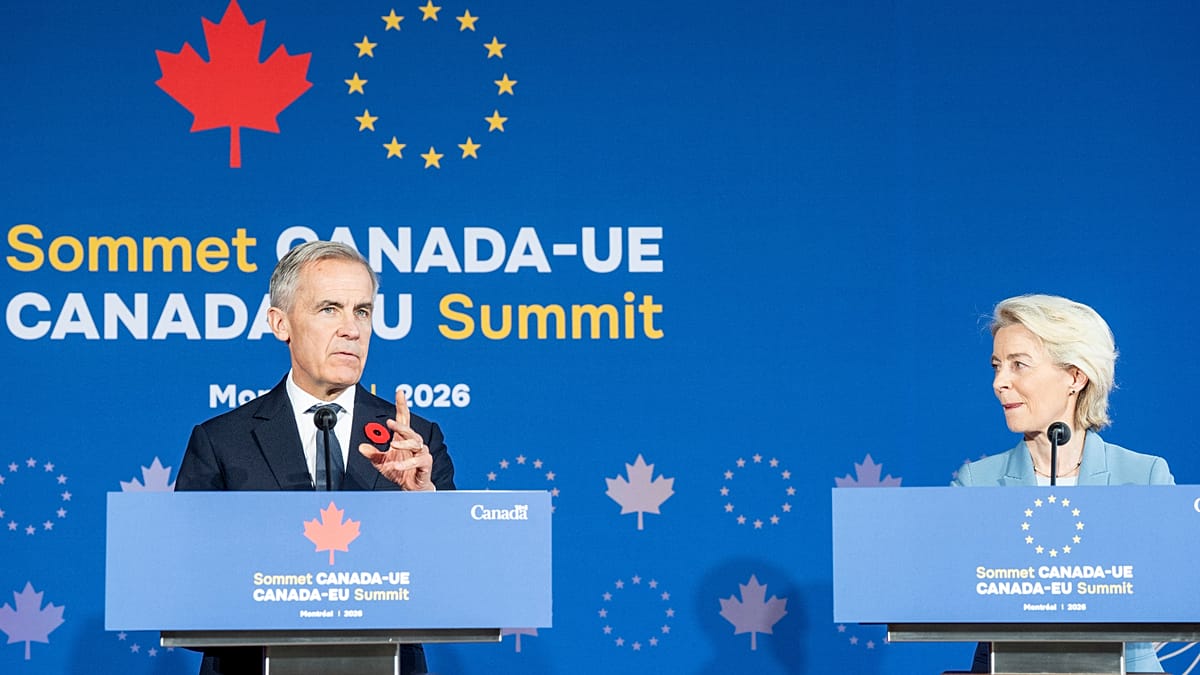
The opposition to the EU's carbon border tax, or the Carbon Border Adjustment Mechanism (CBAM), could potentially strain the budding energy alliance between Brussels and Ottawa, which was celebrated at the Montreal summit on October 29-30. However, when asked about Canada's support for CBAM, Minister Dabrusin offered no explicit endorsement.
The internal document from Canada's trade and foreign affairs ministries reveals that Ottawa is seeking a practical agreement with the EU to reduce the administrative burden on Canadian exporters. At the summit's closing press conference, Canadian Prime Minister Mark Carney acknowledged discussions on various trade issues but did not disclose specific details.
"We are working together to find common solutions (on CBAM and other trade issues)," Carney told reporters. His efforts to diversify Canadian trade away from its heavy reliance on Washington have made access to the EU market increasingly vital. However, the Canadian document identifies CBAM as a potential obstacle to expanding exports to Europe, particularly in sectors like aluminum, steel, critical minerals, and hydrogen.
Despite Canada's existing carbon-pricing policies and its close trade relationship with the EU under the Comprehensive Economic and Trade Agreement (CETA), the country does not qualify for an exemption from CBAM. Ottawa wants Brussels to recognize its domestic carbon-pricing system as comparable to the EU's, aiming to reduce administrative and financial burdens on Canadian businesses.
Critics argue that the EU's requirements and costs are likely to be passed on to exporters through commercial agreements. Stephanie Kusie, the Canadian Conservatives' shadow minister for international trade, expressed concerns about the impact of CBAM on businesses.
"Canada is facing an EU carbon tariff in the coming months that could affect $3 billion in Canadian exports. Instead of fixing the issue, the PM has spent months distracting Canadians with talk of the EU," Kusie said. Between 2021 and 2024, Canadian exports of goods covered by the EU's carbon border mechanism averaged C$28 billion annually, representing 7.4% of Canada's exports to the bloc.
Minister Dabrusin emphasized the Canadian government's support for industrial carbon pricing, which has been in place for years and intends to be strengthened. She argued that industrial carbon pricing is among the most effective ways to reduce emissions while maintaining competitiveness in a global economy shifting towards lower-carbon production.
However, despite Canada's own industrial carbon-pricing system, it is not exempt from the EU's carbon border levy. The bloc's rules link a full exemption to participation in or a connection with the EU Emissions Trading System, a condition Canada currently does not meet. Moreover, the EU's carbon price is significantly higher than Canada's domestic carbon price trajectory.
The EU-Canada summit took place as the EU seeks to build a network of trusted economic partners amid souring relations with the United States. Canadian Prime Minister Mark Carney expressed Ottawa's ambition to become an associate member by June next year. However, divergences over the nature of this renewed relationship, particularly regarding the definition of associate membership, have been voiced by several member states, led by Germany.
Minister Dabrusin emphasized the importance of substance over semantics for Canada, stating, "The main thing for us is deepening the relationship with the EU (...) The conversations we had today underlined how much we have in common in terms of interests and values, and these are things we can build on as we launch the Alliance for the Future." The discussions at the summit underscored the shared interests and values between Canada and the EU, laying the groundwork for the Alliance for the Future.

